
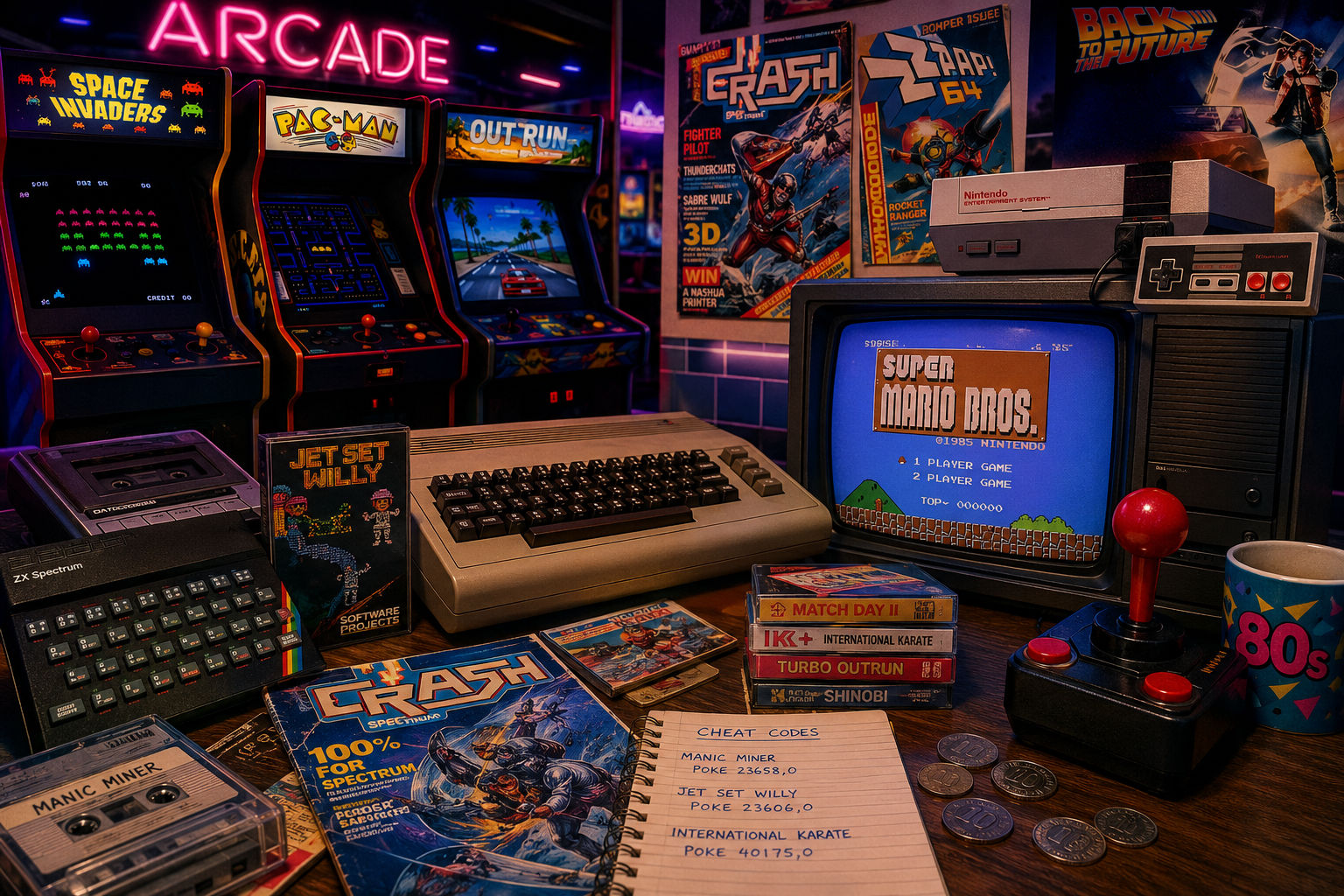
1980s GAMING MEMORIES
Growing Up Gaming in 1980s Britain: Arcades, Joysticks and Pixelated Dreams
If you were a teenage boy in the UK during the 1980s, video games weren’t just a hobby — they were an obsession, a social life, a weekly ritual and, occasionally, a reason for getting shouted at by your parents for tying up the television for six hours straight.
Long before online gaming, downloadable updates and ultra-realistic graphics, we had flickering CRT screens, screeching cassette tapes and joysticks that barely survived a summer holiday. And honestly? We loved every second of it.
The golden age of gaming in Britain really began in the arcades. Before most of us even owned a computer or console, there were the glowing temples of gaming found in seaside towns, shopping centres and bowling alleys. Walking into an arcade in the early 80s was sensory overload. The sound of explosions, electronic music, bleeps and coins clattering into machines created a soundtrack every Gen X gamer still remembers instantly.
Games like Space Invaders, Pac-Man and Donkey Kong were legendary. You’d stand watching older kids play, desperately hoping they’d lose so you could jump on next. Mastering a game wasn’t just fun — it earned respect. If someone could complete a difficult level or get their initials on the high score table, they became a local celebrity for the afternoon.
But for many British teenagers, the real revolution happened when home computers arrived.
Suddenly, gaming wasn’t something reserved for trips to the seaside or the arcade. It was in your bedroom.
The mighty ZX Spectrum became the king of British gaming bedrooms. Cheap enough for parents to consider buying “for educational purposes,” it introduced an entire generation to loading screens, rubber keys and the agonising scream of cassette tapes loading games for what felt like forever. You’d spend ten minutes waiting for a game to load, only for it to crash right at the end. And somehow, that was perfectly normal.
The games themselves were magical. Titles like Manic Miner and Jet Set Willy became playground talking points across the country. We swapped tips in school corridors, copied games onto cassette tapes and argued endlessly about which computer was best.
Because make no mistake — the gaming tribalism was real.
Spectrum owners mocked the graphics of the Commodore 64 while secretly envying its sound. Commodore owners looked down on the Spectrum’s colour clash. Meanwhile, kids lucky enough to own an Amstrad CPC 464 proudly showed off their built-in cassette decks like they were futuristic technology from NASA.
Then came the schoolyard dream machine: the Nintendo Entertainment System. By the late 80s, Nintendo transformed gaming entirely. Super Mario Bros. felt impossibly smooth and colourful compared to the games many of us had grown up with. Suddenly gaming looked slick, exciting and genuinely cool.
Of course, not everyone could afford the latest gear. Many of us relied on birthdays, Christmases or saving pocket money for months to buy a single game. Walking into places like WHSmith or Boots and staring at rows of cassette games was practically torture. You’d spend ages studying the box art, which often looked far more impressive than the actual game graphics.
Gaming magazines became essential reading too. Titles like Crash, Zzap!64 and Computer & Video Games were sacred texts for young gamers. You’d read reviews over and over, memorise cheat codes and stare at screenshots imagining how amazing a game must be. Sometimes the magazines even included free cover tapes, which felt like Christmas had arrived early.
And then there were the multiplayer moments.
Long before internet gaming, multiplayer meant physically sitting next to your mates in a cramped bedroom, arguing over whose turn it was. Winning mattered. Losing led to accusations of cheating. Friendships were tested during endless matches of International Karate or football games where the controls barely worked properly.
Arcades remained special throughout the decade though. There was always something more advanced there than anything you had at home. Games like Out Run, Double Dragon and After Burner felt almost futuristic. The sit-down cabinets, hydraulic motion seats and huge colourful graphics were impossible to match in your bedroom.
For many British teenagers, summer holidays meant spending half the day on amusement arcades at places like Blackpool, Brighton or Skegness. You’d arrive with a pocket full of 10p coins and somehow leave broke within an hour, convinced the next credit would finally be the one where you completed the game.
What made 80s gaming so memorable wasn’t just the games themselves — it was the excitement surrounding them. Every new console or computer genuinely felt like stepping into the future. Technology was evolving so quickly that each year brought something astonishingly new.
Today’s games are undeniably incredible. The graphics are cinematic, worlds are massive and online gaming connects millions of players instantly. But there was something uniquely magical about 80s gaming. Maybe it was the imagination required to turn blocky pixels into epic adventures. Maybe it was the thrill of discovering secret levels without the internet spoiling everything. Or maybe it was simply because gaming still felt new, mysterious and full of possibility.
For those of us who grew up during that era, the sound of a cassette loading or the sight of an old arcade cabinet still triggers instant nostalgia. It takes us back to a simpler time — when all you needed for the perfect Saturday was a joystick, a few friends and enough spare change for “just one more go.”